
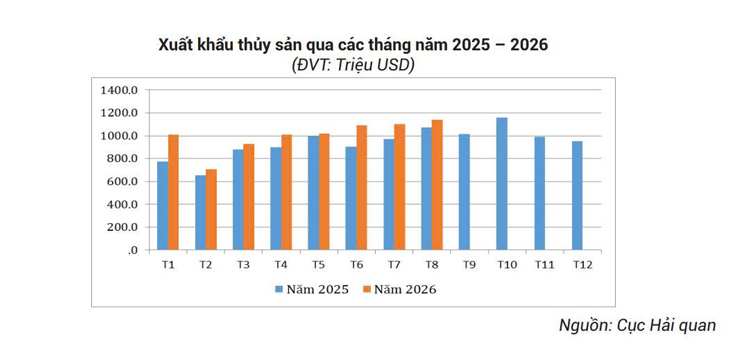
Vietnam's seafood exports maintained their growth momentum during the first eight months of 2026, reaching nearly US$8 billion—an increase of 11.8% year-on-year. Many markets recorded positive growth; meanwhile, the EU remains a market with significant potential but imposes increasingly stringent requirements regarding sustainable development.
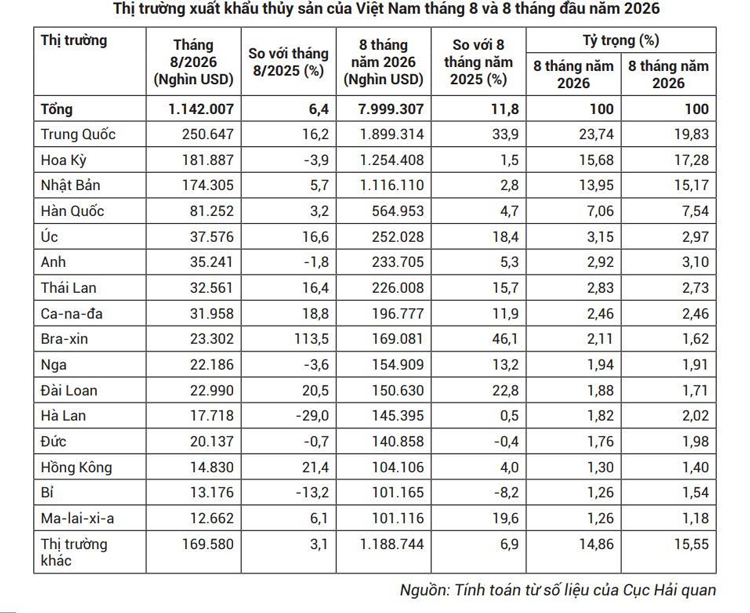
According to the General Department of Vietnam Customs, Vietnam's seafood exports reached US$1.14 billion in August 2026, a 6.4% increase compared to August 2025. During the month, exports to the United States, the UK, and Russia declined year-on-year, whereas many other major markets continued to grow.
Notably, Brazil recorded the strongest growth in August, with export value surging by 113.5% year-on-year. This result indicates significant potential for expanding Vietnam's seafood market presence beyond traditional destinations.
In the first eight months of the year, Vietnam's seafood exports totaled US$7.99 billion, up 11.8% compared to the same period in 2025. China remained the largest export market, accounting for 23.74% of the total value, followed by the United States (15.68%), Japan (13.95%), South Korea (7.06%), Australia (3.15%), and the UK (2.92%). Other markets accounted for the remaining 33.49%.
Most key markets recorded growth. Specifically, exports to Brazil rose by 46.1%, China by 33.9%, and Taiwan by 22.8% compared to the same period in 2025.
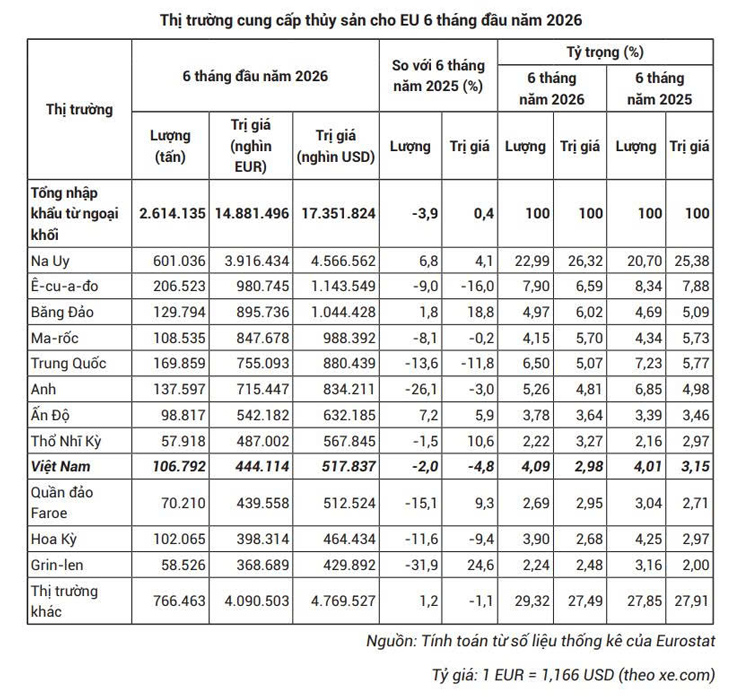
The EU, one of the world's major seafood markets, continues to see high import demand. According to Eurostat, in the first six months of 2026, the EU imported 2.6 million tonnes of seafood from markets outside the bloc, valued at €14.88 billion (equivalent to US$17.35 billion). Compared to the same period in 2025, import volume fell by 3.9%, while value rose by 0.4%.
Against this backdrop, EU seafood imports from Vietnam declined by 2% in volume and 4.8% in value. Vietnamese seafood accounted for 4.09% of the volume and 2.98% of the value of the EU's total seafood imports from non-bloc markets.
Nevertheless, the EU remains a promising market for Vietnamese seafood, as the region imports over 70% of its consumed seafood due to declining domestic catches and slow growth in aquaculture. Demand for products such as shrimp, tuna, squid, and octopus remains strong, particularly in Southern European countries and major distribution hubs.
To better capitalize on this market, the Vietnamese seafood industry must continue to enhance product value while meeting quality and sustainability standards. In particular, the process of lifting the IUU "yellow card" remains a critical factor directly influencing the ability to expand and maintain Vietnam's seafood market share in the EU.